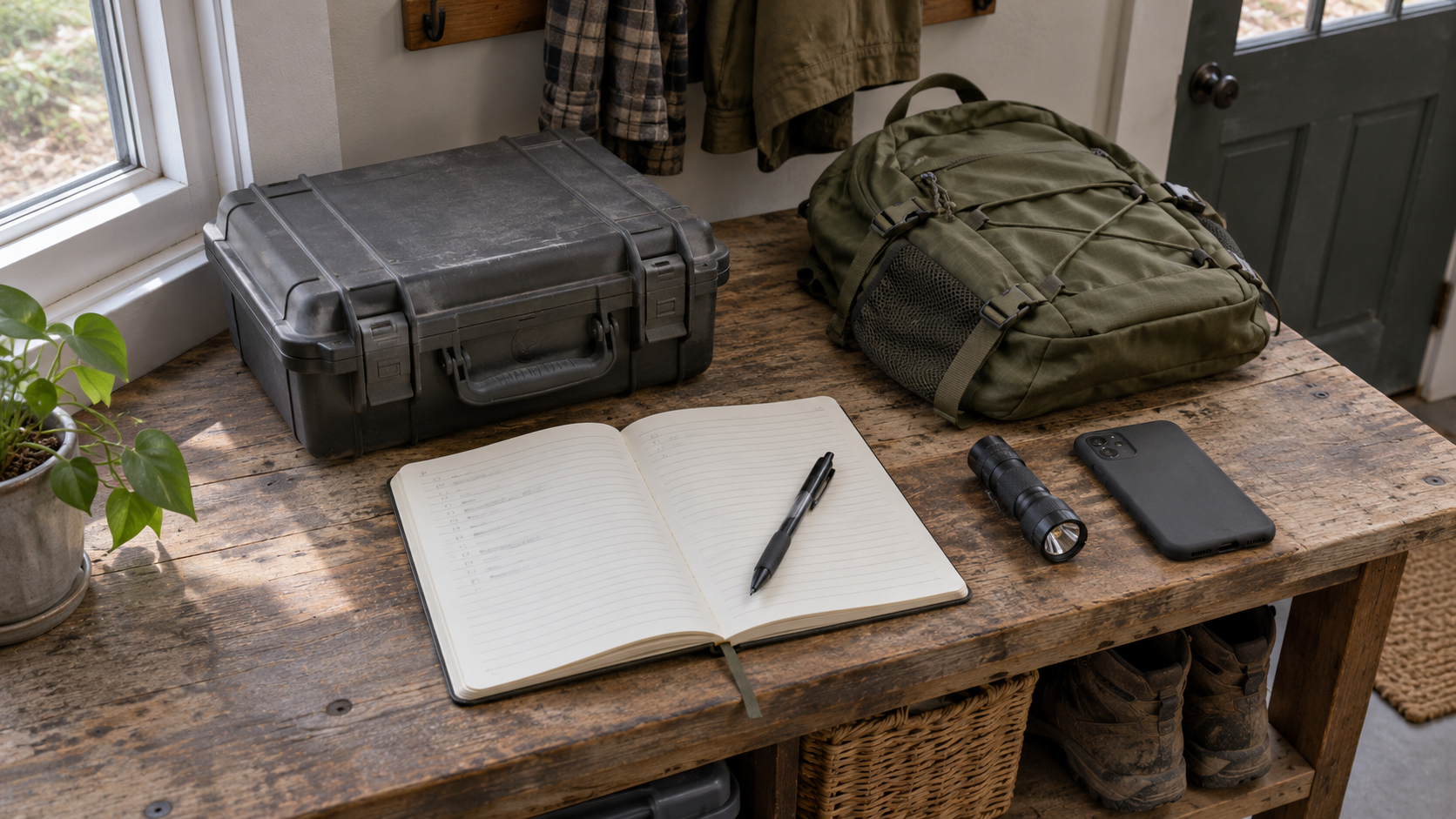
You probably know where your emergency lantern lives. Could you name its model, find the purchase receipt, and tell someone else where to look while you’re away from home?
That’s what a home gear inventory helps you do. It records what you own, where ordinary supplies belong, and what needs attention before the next storm, camping trip, or household move. A few photos and a short spreadsheet can save you from buying duplicates or discovering that an important accessory disappeared months ago.
Start with the equipment you’d have the hardest time identifying or replacing from memory. You can build the first version in one sitting and add the rest as you use it.
Start With One Shelf or One Kit
Pick a space you can finish today. That might be the garage shelf where you keep your camping equipment, the hall closet with your emergency supplies, or the cabinet where you store radios and chargers. A small, complete inventory gives you something you can use immediately.
Take a wide photo of the shelf or kit first. Then give individual entries to items you’d want to identify precisely, such as a portable power station, a weather radio, or an expensive backpack. Group inexpensive items you buy and replace together. A single entry for a pack of spare batteries is usually enough.
Give your storage areas plain names. “Hall closet, top shelf” is easy to follow. “Preparedness Zone 2” requires someone to remember what you meant.
Record Details That Help You Find and Identify Each Item
A spreadsheet works well because you can search it from your phone. A notebook works if you’re more likely to keep it current. Use the same fields for every entry so you can find information quickly later.
| Field | Example entry |
|---|---|
| Item | Rechargeable camping lantern |
| Brand and model | Copy the details from the product label |
| Quantity | 1 |
| Storage location | Hall closet, top shelf |
| Condition | Working, charging cable included |
| Photo or receipt | camping-lantern-receipt.pdf |
| Next action | Check charge before the next camping trip |
Add a purchase date, receipt, or serial number when the information is useful and available. If an item is part of a kit, list the accessories that would be easy to leave behind. A lantern entry that names its cable, or a radio entry that names its adapter, can save a search through a drawer full of similar cords.
If you keep private ownership records for firearms or other sensitive items, restrict access to those records. Leave serial numbers and secure storage details out of the shared household checklist.
Take Photos You’ll Recognize Later
A useful inventory photo answers a question. What does the item look like? Which model is it? Which accessories belong with it?
For higher-value gear, take one photo of the whole item and another of the label if you need it to identify the model. If you have a receipt, save it with a name that connects it to the item. A folder full of files called IMG_4021 will take longer to search than one with descriptive names.
Try using the same name in the spreadsheet and the photo folder. If your entry says “camping lantern,” use a filename such as camping-lantern-model-label.jpg. That simple habit matters more as the inventory grows.
Give the Household Checklist a Job
The shared checklist should help someone complete an ordinary task without calling you. If a storm is on the way, can they find the lantern and its charger? If you’re packing for a weekend away, can they tell which storage bin holds the rain covers?
Try the checklist yourself a week after you make it. Pick one item and follow the written directions. If you have to open three containers to find it, update the entry while you’re standing in front of the right one.
Keep a secure backup of the private inventory and check that you can open it from another device. If you also use a printed list for power outages, include the everyday supplies and their locations so the printout serves a clear purpose.
Update the Inventory When the Gear Changes
Update an entry when you buy, sell, lend, replace, or move something. For routine supplies, a short review before camping season or your area’s severe weather season is a natural time to check quantities and record anything that needs attention.
Pay particular attention to borrowed items and missing accessories. A line that says “loaned to Alex in May” is more useful than a row that still says “in garage.” A “replace cable” note tells you exactly what to handle before your next trip.
Start tonight with five items. Photograph them, write down where they belong, and give each one a clear entry. The next time you need to find a missing charger or identify a model number, you’ll already know where to look.